
Listening to Melba…
Part One of Two
Listening to Melba… a brief review of the voice recordings on compact disc, 100 Years after her Covent Garden Farewell where she made some of her last recordings. This article has been written to accompany OWLS presentations about Melba’s life and career. It gives ready access to things that might (though not necessarily) be difficult to find in a Google or other internet search. Having several examples available in one place might encourage hesitant people to listen.
What follows here is a brief introduction to some of the recordings of Dame Nellie Melba. It commences with the Lionel Mapleson cylinders made at the Metropolitan Opera in 1901/1902 and finishes with Melba’s Covent Garden Farewell, one hundred years ago on 8 June, 1926. It will be a useful reminder of the great singer’s contribution to an international awareness of Australia and Australians.
The year 1926 saw Melba’s Farewell to the Covent Garden opera stage and, in effect, her farewell to opera. (Late in that year she made her last sound recording.) To celebrate the centenary of these events, the NFSA Owls has assembled this overview of some of the compact disc recordings of Melba’s voice from some of the earliest to the last attempt to capture it. It seems likely that in the late 1890s an entrepreneurial sound recordist, Gianni Bettini made a few Melba cylinders, though none of these appears to have survived. (That might change.)
Early in 1901 another man with a primitive domestic sound recording apparatus - the Metropolitan Opera’s librarian, Lionel Mapleson - captured some of the singing from live performances at the Metropolitan Opera House, New York. These recordings include rarities such as Melba’s essaying Marguerite de Valois air from Meyerbeer’s Les Huguenots. It is also interesting to hear something of the power of Melba’s voice when singing with a tenor and baritone in the Finale from Faust (Charles Gounod)
In addition, recordings made in 1926 at Covent Garden, toward the end of Melba’s life, provide an opportunity to hear Melba’s voice as it was captured in some of the earliest use of a microphone. And, we are lucky enough to have access to recently discovered well-preserved metal parts that were a component of the pressing process for shellac and (later) vinyl records.
Many of these performances have been released in audio formats that pre-date the CD. The NFSA used examples from the Archive’s Hogarth Melba Collection to make the master for the first Melba CD in 1988. This selection is an overview of the CD’s that have followed, culminating in Melba’s First Recordings.
As shops sell diminishing numbers of compact discs and CD players are no longer ‘standard’ in motor cars, there is value in examining what has been available to listeners in the several decades, just passed. CD players have been customary pieces of equipment in vehicles for about forty years, from about 1980 to 2020. But in homes and cars, they have been replaced with connections for pen drives and internet access on computers.
At the centenary of Melba’s Covent Garden Farewell, is useful to undertake a short critical survey of Dame Nellie’s singing, recorded on the technology as it became available to her near the peak of her powers as a singer, especially in the first couple of decades of the 20th century. After initial resistance she felt that there might be some use in preserving samples of her singing for students to study when she was not present. (She even made a few recordings of vocal exercises to augment songs and aria she had already recorded.)
The history of sound recording is marked by evolving fidelity to the sound source.
Initially, Melba rejected attempt to secure and fix her singing. (It is said that she asked that recordings made for Bettini in New York in the middle-1890s be destroyed, and that she was dissatisfied with the early discs made in 1904. The latter might be useful, she is supposed to have already noted, as adjuncts to teaching vocal arts.
The Gramophone and Typewriter Company (later HMV and then EMI), in the year that Melba endorsed the notion sound recordings might preserve something of her vocal quality made an released a special Melba record player. In the fashion of the times, it was probably used to attract Melba to the G and T company… and the ploy worked. This video from a North American collector, illustrates and demonstrates, perhaps, what so caused Melba to change her mind.
https://www.youtube.com/watch?v=bWxPYIln2lc
Changes in how sounds are recorded and disseminated has shown steady progress over the years… the transition from shellac 78s in the 1950s and 60s to vinyl long playing discs, the CD supplanting vinyl in the 1980s. The resurgence of vinyl and the apparent phasing out of CDs, are all possibly a part of an inevitable evolution, though the move seems likely to be driven by some sort of commercial imperative.
In 1926, the company that became (I think) EMI, determined to capture something of a voice that had entertained and sometimes astonished the world. It was likely to be the last opportunity to secure the most up-to-date and hence technologically advanced recordings possible at the time. So, to mark that innovative thinking and Melba’s farewell to the opera stage, we are able to trace her progress in the sound recording industry with reference to the remastering of early recordings to make them available to new audiences. Often that meant various sorts of filtering out of surface noise. At times, there have been efforts at digital reconstruction. And also, there have been attempts at a sort of minimal interference with the ‘original’ sound: playing records of historically ‘correct’ record players (that were roughly contemporary with the discs being played on them). There is one example here, though the CD catalogues once had numerous records where a digital recording of an old record player playing vintage records were offered as some sort of access to the close hearing of the original recording.
But why might we bother listening to heritage material such as the tracks available here?
Part of the answer is to do with Melba’s national and international significance. There is little doubt that Melba was the first Australian singer to become very well-known on the majority of the World’s continents. We might even say that she was the first internationally known Australian. First, it was her singing in live performances (especially opera) that established her fame. This was followed towards the end of her career as a recording artist.
And so, let’s begin as close as we are able to come to the beginning of Melba’s recording career.
DISC ONE (Eklipse. Two tracks):
The first item here is an Eklipse compact disc published in 1992. It contains both those final Covent Garden microphone recordings and, at the other end of the chronology items recorded at the Metropolitan Opera in 1901. (It also includes Melba’s very last recording made in New York in December 1926. This is included here from a more recent transfer to CD and might be compared with the early digitisation on the Eklipse CD.) The difference in sound quality is, of course (and as might be expected) very marked. In the 1901 recordings Melba’s voice cuts through the heavy ‘chip frying’ surface noise, common, though not always as pronounced, as it is on early wax, ‘field’ recordings. (It is sometimes said that too much digital interference with the old recording is likely to remove some of the qualities of the recorded voice.)
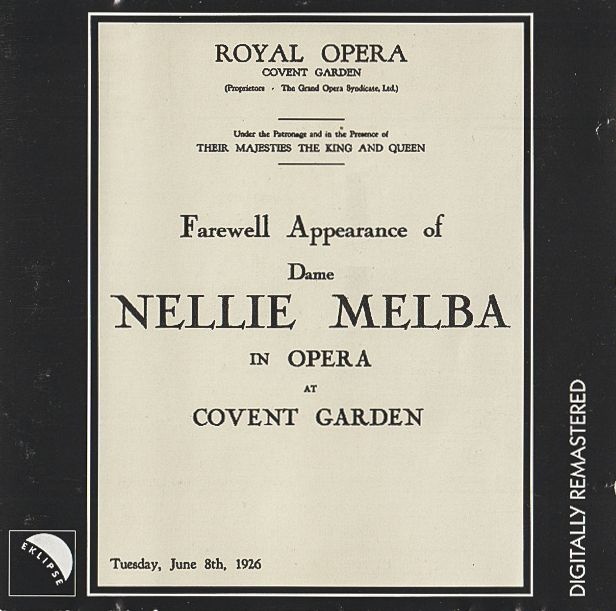
If you are unfamiliar with the sound of recordings from the first decade or so of sound recorded history, then it is worth adjusting your ears. If your listening was conditioned in the years of relative high fidelity to a sound source, then patience is recommended.
The first example, then, was recorded from the orchestra pit (perhaps) at the Metropolitan Opera House, New York. This is the trio finale from Faust (Charles Gounod). The other singers are Edouard de Reszke and Albert Saleza. The audible surface noise is characteristic of early cylinder recordings that usually rotate at about 160 revolutions per minute. (this is the unfamiliar surface noise you will hear.) Mapleson was able to make numerous recordings at the Met between 1901 and 1903. He caught the power, flexibility and range of Melba’s voice.
(The Eklipse CD has been ‘quarried’ for YouTube and offers audio as well as few images at the following address.
https://www.youtube.com/watch?v=735ENkIrPMI )
At the other end of the Melba recording ‘chronology’, then, are the Covent Garden recordings that are also presented on this CD. Melba is assisted in this performance by three other Australian singers. In addition to Melba, who sang Mimi, the recording includes her fellow Australian artists Browning Mummery (Rudolpho), John Brownlee (Marcello) and Fred Collier (Schaunard).
This recording demonstrates the effect of a few technical difficulties experienced with early, live recording. Apparently, nobody bothered to set up an intercom between recording van, parked outside the Royal Opera House, London, and anyone inside the building who might have been able to cue the engineers to ‘start’ or to ‘stop’ recording, by signalling ‘Record’ of ‘stop recording, now’! Still, it’s a wonderful collection of historical sounds and includes a couple of speeches. That means we have access to Melba’s speaking voice when she was sixty five. (OWLS might look more closely at these Covent Garden Farewell recordings as a group later.)
At her 1926 Covent Garden Farwell Concert Melba sang Act 2 of Romeo and Juliet, Act IV of Verdi’s Otello and Acts 111 and IV of the work she had made her own, La Bohéme. Because the recording apparatus was housed in a truck outside the Royal Opera House, there was minimal contact with the activity on the Covent Garden stage. As a result, there is occasional awkwardness about the start and finish of recordings. Romeo and Juliet was not recorded as the tenor (Romeo) was contracted to another recording company at the time. Our loss! However, we will be able to compare this extract with the 1910 American recordings. See Audio 6.
DISC TWO (NFSA/Larrikin. 1988/re-released 1996).
Hogarth Melba CD: Tr 1 Comin’ Thro’ the Rye
This was, as far as we can tell, the very first published CD dedicated to Melba’s singing. It was made at the NFSA in 1988. It drew on recordings available in the Archive’s Hogarth-Melba Collection of (mainly) shellac discs Melba made between 1904 and 1926. This was the first of the Archive’s releases of re-mastered 78rpm recordings on CD. It was processed in the NFSA studios. Considerable effort was expended on determining the correct playback speed that was based on discovering the likely original pitch. NFSA sound engineer, Wanda Lazar played a crucial role in determining a variety of technical issues such as these.
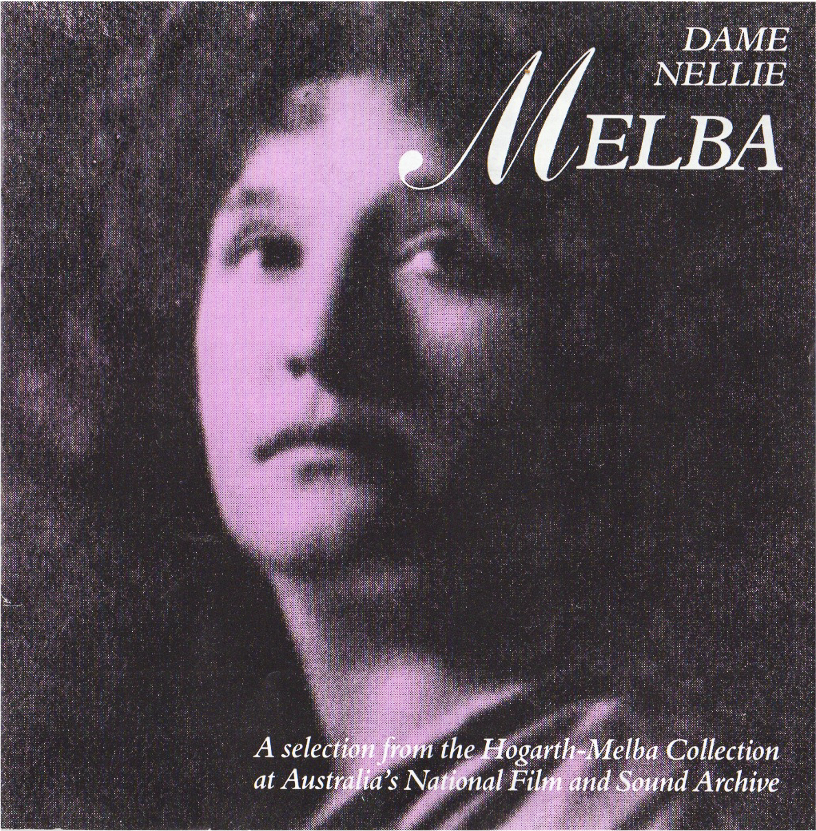
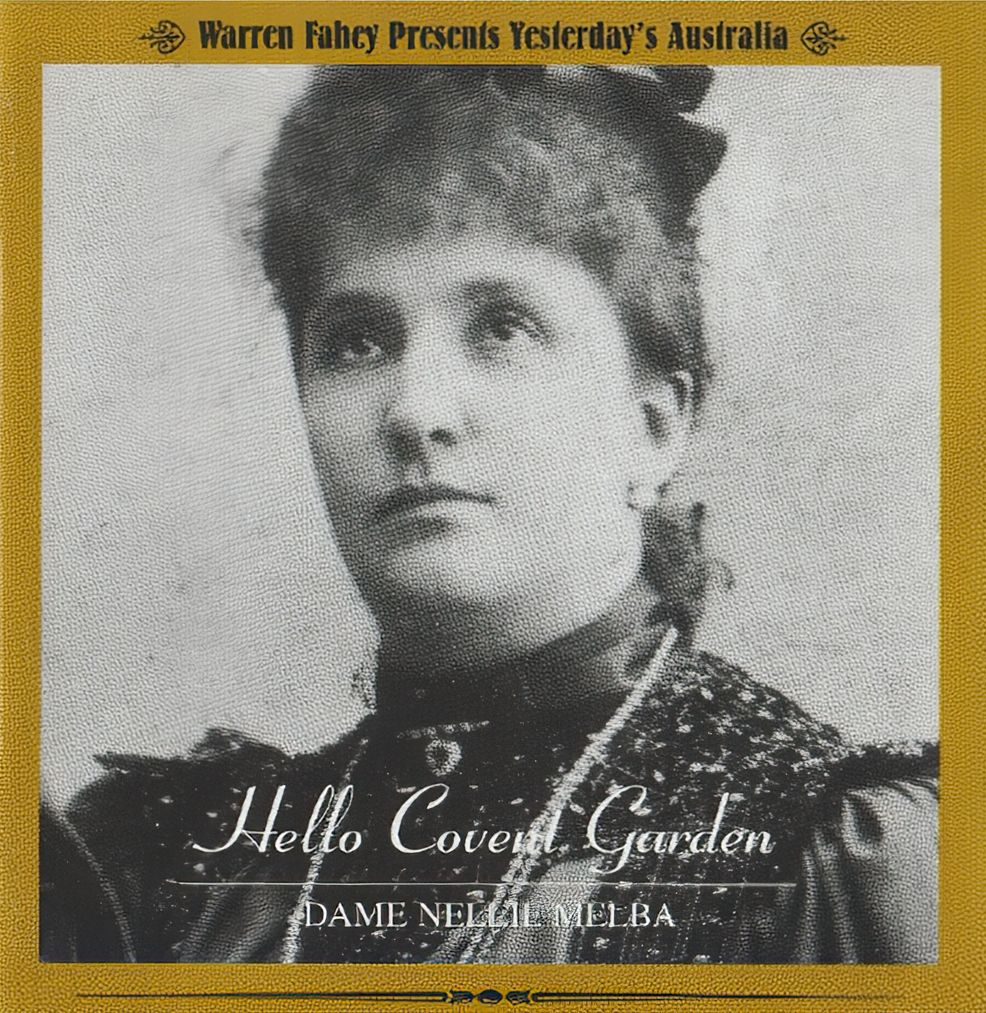
In 1996 the NFSA-mastered CD record was released for a second time under a new title, Hello Covent Garden. A note claims that it was produced by Kingfisher Records.
The original release had been from the NFSA and Larrikin. It was now a Warren Fahey product, the NFSA acknowledged in largely unaltered liner-notes. The original Larrikin Voice of Australia logo now a plain, single word, Larrikin. New information on the inlay card states that this is ‘A Peter Burgis Kingfisher Production’. Important as Peter had been to establishment of the national collection, he was not the producer of this disc. It is not clear where the new title Hello Covent Garden came from.
‘Comin’ throu’ the Rye’ is (obviously) available on both CDs.
Melba recorded several popular Scots songs, this one in 1904. This NFSA recording was the first CD to bring together twenty-one of Melba’s most popular arias and songs and was produced by the Archive in 1988.
On 27 September 1902 for her second encore at a Melbourne Town Hall concert, touchingly, Melba sang directly to her father - David Mitchell, a Scots emigrant to Australia - who was seated in the balcony. Mitchell had had a stroke at the railway station in Albury a week or two before, while waiting to greet his daughter who was about to arrive there on her way from Sydney to Melbourne. It was necessary to stop there to change trains. A Victorian gauge train could carry a passenger from Melbourne to the Murray, where it was necessary to transfer to trains with the different NSW rail- gauge to complete the journey to Sydney. (And,vice versa.) Melba’s suggested to a giddy Melbourne press after the Melbourne Town Hall concert, that this music was an example of a ’song my father taught me’.
A second NFSA CD was released in 2002, when the Archive briefly carried a new name ScreenSound Australia. (It is included here out of chronological sequence in order to follow the Archive’s first Melba release.) For the second Melba CDs – there was a set of two CDs - original recordings were played in the Senate Chamber of Old Parliament House, Canberra on an HMV Re-entrant 202, a top-end domestic shellac disc machine. The sound issuing from the 1929 record player was then digitally recorded. The careful selection of items to record was dictated, to some degree, by the availability from the Archive’s collection, of discs that were not too worn. Those who engineered the transfers noted a considerable improvement in the spaciousness of the sound, especially in Melba’s low register.

DISC THREE (NFSA. 2001)
Mi chiamano Mimi – complete): CD 1, Track 2
The NFSA, then, took the opportunity to digitally record an His Master’s Voice (HMV) record player, playing the early discs, capturing to some degree what might have been heard in parlours where the piano had once been regnant. (Computer asks me if this should be ‘the piano once was pregnant’. So much for new technologies and artificial intelligence.)
The imaginative decision to re-record Melba from discs being played on an historical record player in an equally historical venue was a piece of archiving brilliance. The player was taken to the Senate Chamber in Old Parliament House (OPH), Canberra. Melba had sung the first verse of the national anthem from the front steps at the official opening of the building and the first Canberra sitting of Federal Parliament, in 1927. That was just a couple of years before the HMV machine used to record the ‘live’ playing was made.
Melba studied La Bohéme and other operas by Puccini, with the composer. This version, then, is an acoustic recording, made in the USA in 1910. This performance was digitally recorded from that HMV record player, playing acoustically in the Senate Chamber of Australia’s Old Parliament House. The record player is a state-of-the-art domestic gramophone. Excellent, comprehensive liner notes, both technical and historical, are provided with the CD.
The NFSA’s talented curatorial staff, added their combined considerable ability to that of the audio-technical staff (including Wanda Lazar, once again) and those responsible for publications. Bruce Skilton’s knowledgeable selection of material and his excellent notes add to the usefulness and enjoyment of these CDs. Only one example from the transfers has been included here. It is a little more from Melba’s La Bohéme. (Bruce has suggested that ‘Magdalene at Michael’s Gate’ [CD 2, Track 15 of the set.] is a Melba recording of exceptional quality and worth a listen.)
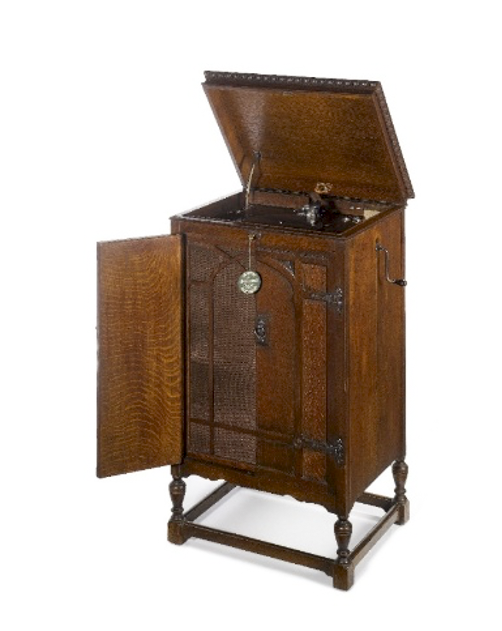
His Master’s Voice (HMV) 202 from an auction catalogue
There have been precedents for re-recording from ‘old’ record players that were contemporary with the material being played. From the 1980s, for example, some of the output of historic and occasionally complete recorded repertoire of particular ‘vintage’ singers, such as Francesco Tamagno, was recorded from (as I recall) an EMG machine with a giant papier mâché horn, by the Pearl and Opal companies. (For much of the 1980s and 1990s presentations at the Archive included a pre-microphone, acoustic disc played from an EMG record player. It was usually an Australian performance, the couple of metres of playback horn, impressing adults and children alike.
The NFSA undertook several experimental re-recordings from this machine in the later 1980s and 1990s. An account of some of this activity can be found in Archive sound engineer, Wanda Lazar’s essay ‘Around the Horn with Amy Castles’ in the Australasian Sound Archive journal, Number 5, April 1988.
https://www.facebook.com/groups/108453762611462/posts/8805794626210622/
The following Youtube video is a useful overview of an EMG record player, playing and also a glimpse of how some listeners from the 1930s heard acoustically reproduced singing. A cursory glance at the internet offerings for EMG produced no Melba discs played on this machine. What follows is the voice of Italian lyric tenor, Beniamino Gigli, singing Ingemisco for the Requiem of Guiseppe Verdi, recorded by Victor in 1939.
(A rough translation of the Latin:
I groan as a guilty one. My face blushes with guilt; spare the supplicant, O God. You, who absolved Mary Magdalen, and heard the prayer of the thief, have given me hope, as well. My prayers are not worthy, but show mercy, O benevolent one, lest I burn forever in fire. Give me a place among the sheep, and separate me from the goats, placing me on your right hand.)
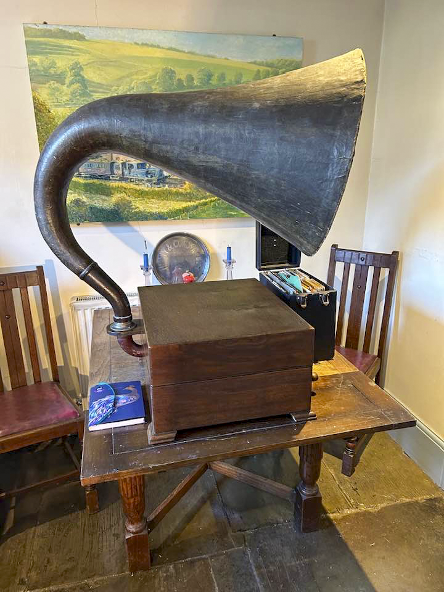
This example of an EMG record player has a smaller horn than the one held by the NFSA. With thanks to Tim Weeks (2025)
